
Virginia Quality Birth to 5
What is VQB5?
Virginia has developed Virginia Quality Birth to 5 (VQB5) to measure and improve the quality of infant, toddler, and preschool classrooms. VQB5 is used in child care centers, family day homes, public school preschools, and Head Start sites. VQB5 helps families learn about different birth-to-five programs so they can choose a program that best meets their needs.
Our goal is that all Virginia children have learning experiences that prepare them for kindergarten. Measuring the quality of these learning experiences helps strengthen programs and provide important information to families
VQB5 sites are focused on providing quality learning experiences for your child. This means your child’s teacher is receiving feedback and support multiple times a year. Your site is also likely using a quality curriculum.
State law requires the VDOE to improve learning experiences for young children so that more children can enter school ready. This information helps the VDOE better understand how all these different early learning experiences support kindergarten readiness.
Federal and state laws protect how child information is used. VDOE will keep child information private and secure. VDOE will never share information in a way that would identify any child or any small group of children
Have Questions?
Email info@foundationfirstva.org
Or visit the Virginia Department of Education’s official webpage about VQB5
There are two parts of VQB5.
-
- VQB5 also looks at whether classrooms are using a quality curriculum that has been approved by the state. Curriculum is always optional, and programs have lots of choices.
-
- Trained observers look at all classrooms using a nationally-regarded early childhood observation tool called CLASS™.
-
- This observation lasts 60-80 minutes. The trained observer focuses on the interactions between teachers and children. This is not a child-level observation.
-
- Teachers receive feedback on what they are doing well and support to improve.
-
- Trained observers look at all classrooms using a nationally-regarded early childhood observation tool called CLASS™.
-
- VQB5 also looks at whether classrooms are using a quality curriculum that has been approved by the state. Curriculum is always optional, and programs have lots of choices.
Birth-to-five early childhood programs who receive government funding are required to take part in VQB5. Programs that do not receive any government funding can choose to take part.
-
- Provide important information about their teachers and classrooms, including child enrollment information to VDOE each fall.
VQB5 sites are required to do the following each year:
-
- Have CLASS™ observations in every infant, toddler, and preschool classroom in the fall and spring.
-
- Report on their use of approved early childhood curriculum.
-
- Provide important information about their teachers and classrooms, including child enrollment information to VDOE each fall.
Understanding the Classroom Assessment Scoring System (CLASS™) Tool
What is CLASS™?
The quality of interactions between teachers and children is measured in VQB5 through use of the nationally recognized Classroom Assessment Scoring System (CLASS™). CLASS™ is a research-based tool that helps educators strengthen the interactions between teachers and children—because strong relationships support learning and healthy development.
In VQB5, over 30,000 CLASS™ observations are completed annually in over 10,000 infant, toddler and preschool classrooms, including family day homes. This provides educators with frequent and actionable feedback to guide improvement.
What does CLASS™ look at?
CLASS™ measures how teachers interact with children in three key areas:
- Emotional Support
- Teachers help children feel safe, cared for, and respected.
- Positive relationships and emotional connections are prioritized.
- Classroom Organization
- Routines are smooth and behavior is managed positively.
- Teachers keep children engaged and help minimize disruptions.
- Instructional Support
- Children are encouraged to think, communicate, and ask questions.
- Teachers promote language, reasoning, and deeper understanding.
How is CLASS™ Used?
- Observers visit classrooms and use CLASS™ to provide helpful feedback
- Teachers and coaches work together to improve classroom interactions
- CLASS™ supports professional growth, not evaluation or judgment
What Does This Mean for Your Child?
When CLASS™ is used regularly:
- Children feel more supported and connected
- Classrooms are more focused and engaging
- Learning outcomes and readiness for school improve
Want to learn more?
Ask your child’s teacher or center director about how CLASS supports your child’s classroom experience.
Interested in using CLASS™ at home?
Check out Teachstone’s take home document-
Quality Profiles
Parents can now access information about quality and safety for more than 3,100+ publicly-funded early childhood sites via the VDOE’s new, easy-to-use online VQB5 Quality Profile website. With information on early childhood sites in every city and county in Virginia, this new tool helps families learn about the quality of the sites to help them choose the best option for their birth-to-five children.
The VQB5 Quality Profile Website includes quality information for publicly-funded sites, including child care centers, family day homes, Head Start, and public school preschool, as well as for privately-funded sites that participated in the VQB5 measurement and improvement system last year.
View a short video – “VQB5 Quality Profiles” (3 min)
VQB5 Honor Roll System
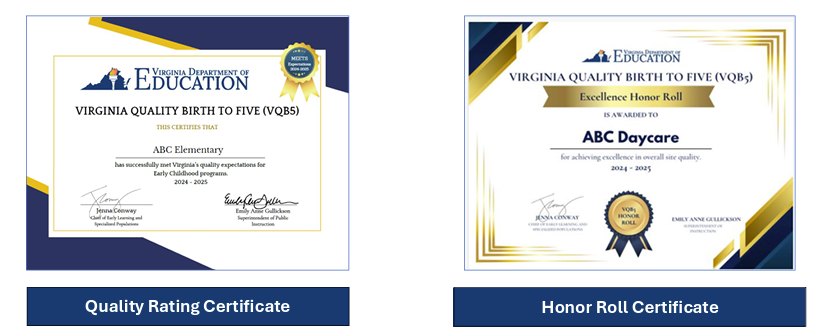
Virginia’s early childhood programs demonstrated both excellence and improvement in 2024-2025. This year, Virginia launched three VQB5 Honor Rolls to recognize 494 early childhood sites:
- Excellence Honor Roll – These earned Exceeds Expectations, the highest possible rating in VQB5. This year, the number of sites that exceed state expectations grew by 28% in Virginia. Considering Virginia uses a rigorous national tool to measure classroom quality, these sites may be considered national exemplars. These exemplars include child care, family day home, Head Start and school sites and are located in all of Virginia’s nine Ready Regions.
- Infant-Toddler Quality Honor Roll – These sites demonstrated top performance in infant/toddler classrooms (top 10% in the state).
- Improvement Honor Roll – These sites showed significant year-over-year gains in teacher-child interactions (top 10% in the state).
Early Childhood Care and Education for Families
From the moment a child is born, they begin learning about the world around them. In the early years, children learn from their parents, family members, and other caring adults. From birth to age five, kids start building the skills they need to be ready for school. The goal is to help every child enter kindergarten ready to learn and grow. Virginia offers many resources to help families, caregivers, and communities prepare children for a strong start in school.
ECE Resource Hub Take-Home Strategies
The ECE Resource Hub’s Take-Home Strategies provide families with engaging activity ideas to support children’s learning and development at home. Updated on a regular basis, activities feature individual skills, aligned with Virginia’s Early Learning and Development Standards, that grow from infancy to preschool can be adapted to every child’s development and fit within their family’s routines, values, culture, and preference. Each take-home strategy page includes:
- Handpicked book recommendations.
- A short description of the skill.
- Multiple, easy-to-adapt activity ideas.
- Quick tips for things adults can do or say to strengthen the skill.